
The coach told you your kid would be important. The club talked about a real role, meaningful minutes, and a plan for development. Then the games started.
Your kid is coming off the bench. Maybe playing a few minutes. Maybe not playing at all. The player is frustrated. The parent is doing the math on the drive home. And the family is asking: how long are we supposed to be patient?
Here is the honest answer. There is no number of games that fits every player. One bad weekend tells you very little. A month of vague answers, changing explanations, and no visible path forward tells you more.
The hard part is knowing the difference between a setback your kid needs to work through and an environment that is no longer helping them develop.
In Make the Smart Move (2026), I call meaningful minutes and role clarity the twin pillars of development. Minutes let a player compete, adjust, and solve problems in real time. Role clarity tells the player what the coach trusts them to do. A player needs both. But neither should be judged from a single lineup.
So before anyone calls the coach or starts looking at another club, slow the situation down.
Start with your kid. Ask what the coach has actually said. Not what your family heard at tryouts. Not what another parent thinks. What feedback has the player received directly? What is happening in training? And the uncomfortable question: does your kid believe they have earned more minutes?
The parent experiences the problem from the stands. The player experiences it all week. If your kid cannot explain what the coach expects, that may be a communication problem. If the expectations are clear and your kid is not meeting them, that may be a development problem. Those require different responses.
Then ask the coach one forward-looking question. First account for what has already been asked, what was promised, and what the player has already been told. Then ask: "What specifically does my child need to demonstrate over the next four weeks to earn more responsibility?"
For an older player, I would usually want the player asking that question, not the parent. Learning to seek clear feedback and respond to it is part of becoming a serious athlete.
This does not ask the coach to guarantee minutes. It asks for a standard the player can work toward. A useful answer is specific: defend more consistently, improve fitness, move the ball faster, win the position in training, understand a tactical responsibility. "Keep working" is encouragement. It is not a plan.
Now watch what happens. Does the player receive opportunities to apply the feedback? Does the explanation stay consistent? Does the role become clearer, even if the minutes do not change immediately? Does the coach's behavior match the coach's words?
Specific feedback, a fair chance to respond, and a role the player can realistically earn point to a difficult but workable situation. Repeated praise, shifting explanations, and no identifiable path to the field point to something else.
This is where patience gets misunderstood. Patience does not mean waiting forever and hoping the situation changes. Patience is a defined period of observation with something concrete to evaluate at the end.
Set the review date. Use the next few weeks to watch the player's response, the coach's communication, and the opportunities being provided. Then reassess from evidence instead of from the emotion of one quiet drive home.
Do not leave just because the situation is hard. Sometimes another player is simply performing better. Your kid may need to improve, adapt, and earn the role. That is part of development.
But do not stay indefinitely because the badge is impressive or because leaving would mean admitting the move did not work. If the player is working, the feedback remains vague, the role keeps shifting, and there is no credible path to meaningful minutes, the environment may no longer be the right one.
The decision is not whether your kid started this weekend. The decision is whether this environment is still giving your kid a real chance to become better.
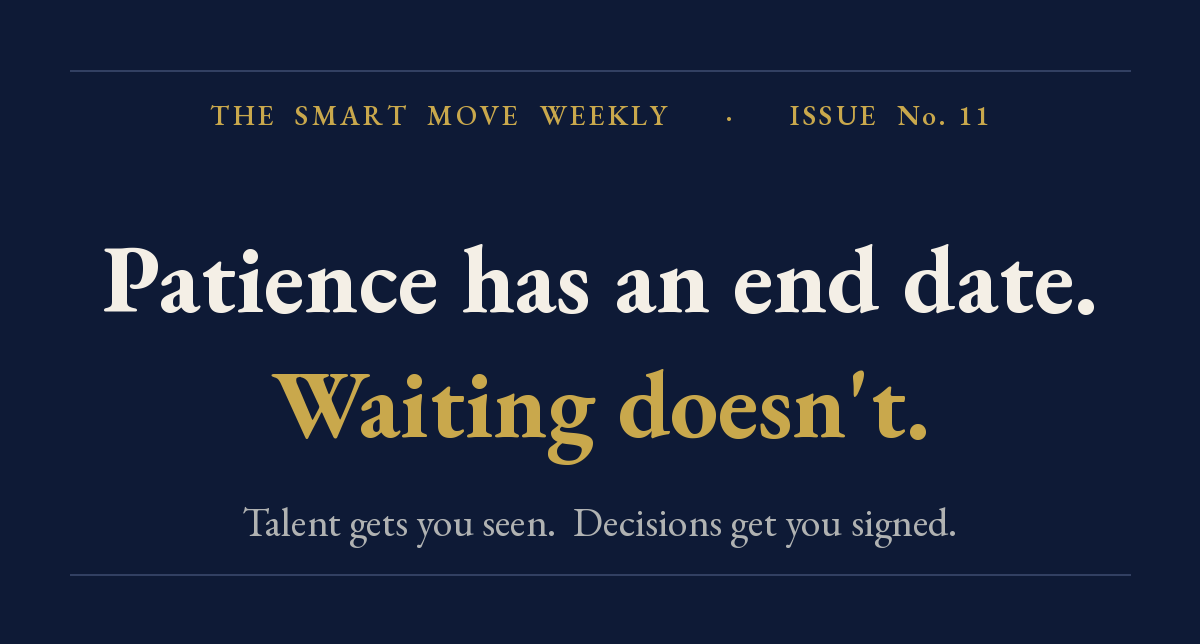
Talent gets you seen. Decisions get you signed.
If the minutes and the promises no longer match, send me both: what your family was told and what is actually happening. That difference is usually where the decision lives.
See you next week.
Mario
General information, not individualized advice. Development framework drawn from Mario Iveljic, Make the Smart Move: The Playbook for Better Sports Decisions, Chapters 3, 4, 7, 8, 20, and 21 (2026). The recommended questions and review process reflect professional judgment; they are not universal rules.